A Brief History of the Novel and Storytelling
Novels are a relatively modern form of storytelling. Since the inception of language stories had been told orally, then suddenly the story became fixed in written word by an author with a very small audience who was assumed to be reading it individually or listening to it being read. This presupposed audiences that could read, means of producing copies of a text, and the cultural onus to create them. The novel appears in a few different places and times: in 17th century Europe with the publishing of Don Quixote, in 11th century Japan with the writing of The Tale of Genji, and even some Greek and Roman prose narratives being called precursors to novels. |
| Don Quixote, by Scott Gustafson |
This contrasts with the oral traditions that is inherently mutable from Teller to Listener, and between tellings from the same Teller. It was this tradition that gave us the Poetic and Prose Eddas, to the Iliad and the Odyssey, and the Ramayana and the Mahabharata (though each of these works are of course know through the written incarnations, not an intact oral history). Works of similar tone or content or form where also composed as a piece of written narrative poetry, a good example is Dante's Divine Comedy (perhaps the first great trilogy). Many of these classic epics come in the form of verse, with the Prose Edda being the glaring exception.
 |
| Illustrations to The Elder Edda by Boris Zaborikhin |
I listen to a podcast, Myths and Legends, and the host Jason Weiser made an interesting point in a recent episode about Paul Bunyan. He retells myths and legends (duh), but in his retelling he edits for clarity and elaborates as he sees fit. He asserts, rightly so I think, that this is very much a part of the traditions that these stories were forged in. The epics listed above would be very strange to the audience they were originally told to, sometimes written hundreds of years after they where being told and often with heavily editorializing by the transcriber to make them a cohesive narrative (for example the Iliad) or to sanitize and Christianize them ( for example the Poetic Edda and the Prose Edda). These are bizarre static stories of a time and place far removed at the time of writing, not composed works like a novel.
Aren't we as roleplayers participating in a modern oral tradition through roleplaying? Right now I am running a two groups in the same setting with no over lap in players, and in the retelling of the aspects there is drift/editorial adjustment between the groups as the encounter similar situations/locations/challenges. These are exactly the kind of adjustments that a story teller would make to improve each retelling and to tailor it to their audiences.
Roleplaying Games as Story Telling
When describing D&D to people I usually fall back onto the analogy of a novel. The players are the main characters in the story, the DM/GM/Referee is everyone and everything else. "You get to play Frodo and the Fellowship of the Ring!" I tell them. Yes there are dice. Yes, some people use a board and little figurines. But those things aren't the point (not necessarily, there are beautiful and deep sub-hobbies around the crafting and enjoyment of gaming artifacts; just look at all of the gaming table or dice tower designs on the web, miniature painting, or novelty chocolate dice). The point is to get together with your friends and collaboratively tell a story.***Thats at least what I tell people. I have seen mummers of contention about this explanation, though only second hand, that we can't play out stories, its only a story if we tell people about it after! I've never seen a convincing argument for this, so if you have some counter points I'd love to see see them.***
It seems to me that pretty damn near EVERY TTRPG game I have played or that I can think of the essential elements of the story. So I'll use some classic examples of D&D modules and other games to demonstrate:
- Characters: Duh, we literally call them that most of the time. Whether they are Player Characters or Non-Player Characters, they are still characters. No example needed really, characters are ubiquitous
- Setting: The place where the events of the game happen. People produce setting documents for their players to orient them to how weird their version of fantasy medieval Europe is. This can be exhaustive (I'm looking at you Greyhawk) or sparse (I'm looking at you Keep on the Borderlands).
- Plot: This is the arc of the narrative, with the beginning (Adventuring around the small hamlet of Hommlet) the middle (Delving into the Temple of Elemental Evil) and end (Visiting the Elemental Nodes to get the key to defeating Zuggtmoy). There is progression and escalating tensions
- Conflict: The reason the characters are involved at all, the tension to be resolved (Delving into the Tomb of Horrors to destroy the demi-lich Acererak) (to stop the horde of Hobgoblins bearing the Red Hand of Doom).
- Resolution: Through playing resolution is achieved, even if that results in character death or unexpected outcomes, at least the game went somewhere.
To the Matter at Hand
So my question is this: do the stories generated through table top role playing games really most closely resemble novels? Can we play out other forms of narrative, like an epic poem? I've seen some very good arguments that the OSR school of thought encourages a more picaresque style of narrative with roguish motivations, so other genres and scales of narrative interest are obviously viable.
I suppose what I want to get at is this: can we explore wider genres with broader scopes of ambition than the novel? Can we play the heroes and gods of Myth and not just characters of Mythic Fantasy? Can we use these games as a vehicle for a modern oral tradition? Is D&D and its many children the system we want? Or is a more narrative focused system like Hillfolk or Skulduggery (both of which are well described here) better suited?
I don't know, but I sure think we should try. Let us set our sites on the horizons and venture into realms that we haven't been to yet. Let is push the limits. Let us engage in an ancient tradition and tell our own epics. D&D may not be the vehicle, though this does seem the realm of epic level play (something I have never seen done well). Let us look for an alternative because old stories deserve to be told, not just read and new stories deserve to be explored, not just dreamed.
I suppose what I want to get at is this: can we explore wider genres with broader scopes of ambition than the novel? Can we play the heroes and gods of Myth and not just characters of Mythic Fantasy? Can we use these games as a vehicle for a modern oral tradition? Is D&D and its many children the system we want? Or is a more narrative focused system like Hillfolk or Skulduggery (both of which are well described here) better suited?
I don't know, but I sure think we should try. Let us set our sites on the horizons and venture into realms that we haven't been to yet. Let is push the limits. Let us engage in an ancient tradition and tell our own epics. D&D may not be the vehicle, though this does seem the realm of epic level play (something I have never seen done well). Let us look for an alternative because old stories deserve to be told, not just read and new stories deserve to be explored, not just dreamed.
 |
| Saturn by Peter Paul Rubens; don't you want to play in a game where you can eat your divine spawn to keep them from over throwing you? |
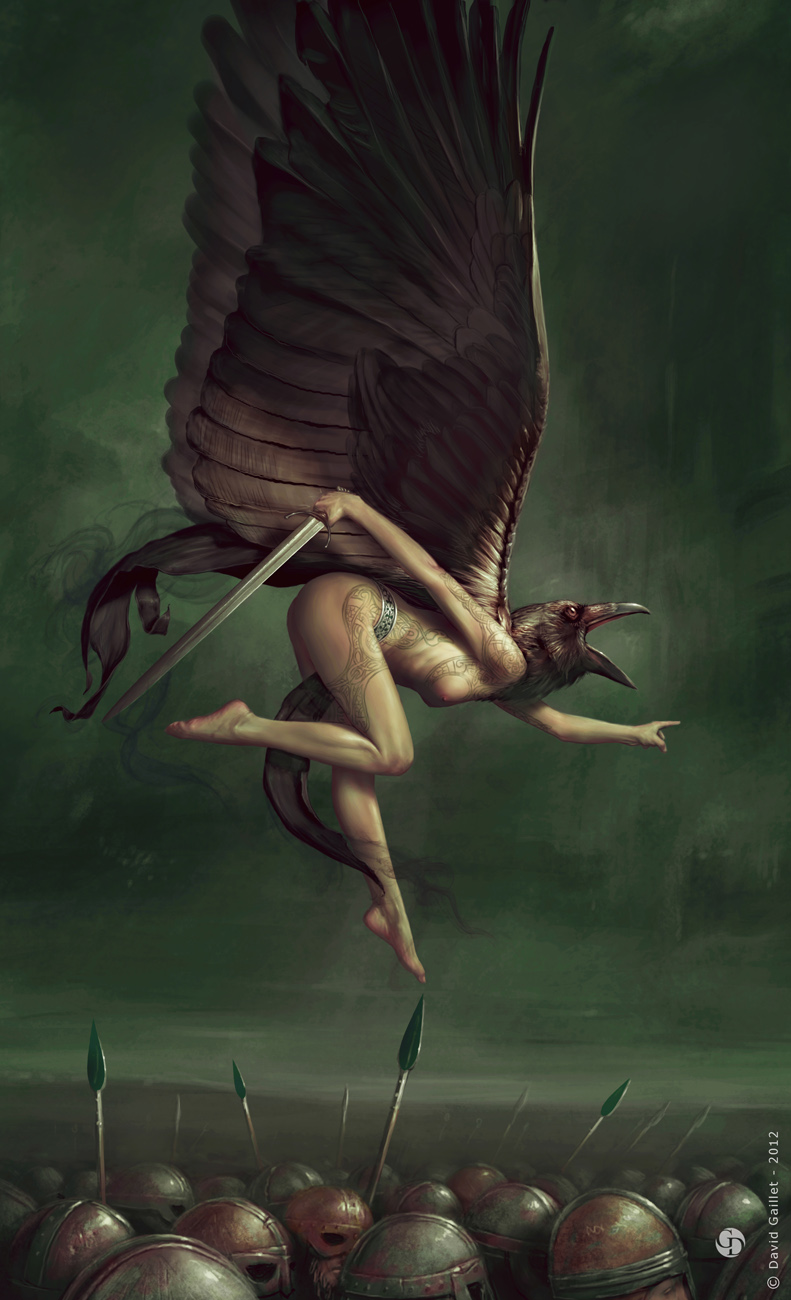 |
| Source, lets play more games with the Morrigan as a character! |
 |
| Source, or Morgoth! |