Treants are trees that should have died a horrible death. Calamity has struck their grove and some animus has seen fit to not only let them survive but become something other than a tree. This is a rare occurrence, even the elves can't reliably awaken treants (though they will claim that thats because the tree wasn't ready yet).
When you stumble across a young treant they often are simply sitting and marveling at their articulating twig joints and the way the other side of that rock looks. It's not until they have weathered a few winters and the novelty has worn off that they begin to seek even more novel horizons. Old treants are prodigious walkers, often covering 30 miles in a day simply for the joy they find in the rhythmic creaking of their wood and the exotic crunches and tastes of distant soils beneath their root pads.
As treants age their forms grow more and more complex (think the incredibly complex and brushy crowns of old growth redwoods) through years of wear and variable climates. An ancient treant hardly looks like the tree it once was, with foreign moistures flowing through it's xylem and distant suns vivifying it's leaves. But they can never truly shrug off their origin, their morphology is plastic but their innermost rings will still tell of their ancient bondage in the place that they first grew.
Don't confuse them with dryads, they hate that. Dryads are the free flowing avatar of the id of a tree and forever tied to their groves. Treants are a wholly tree realized as a walking, talking, growing entity. Fuck dryads, those whimsy fucks.
If you want to generate a random treant use the table below:
(Gosh writing tables like this is fun) (It's also really hard for me to pick proto-typic/ universally recognizable trees. I was going to write about the habits of each of the 10 above, but then I thought that no one would give a hoot. So I didn't. Let me know if you give a hoot.)
This might be helpful for understanding their original biome.
How to use the above generator:
The tree type tells you some personality details of the treant (pines are hardy and drought tolerant, so a pine treant might be stubborn and resourceful).
The biome they grew up in is like the circumstances of their childhood, was it a hard lonely life (like the alpine) or an easy social life (like the rainforest)?
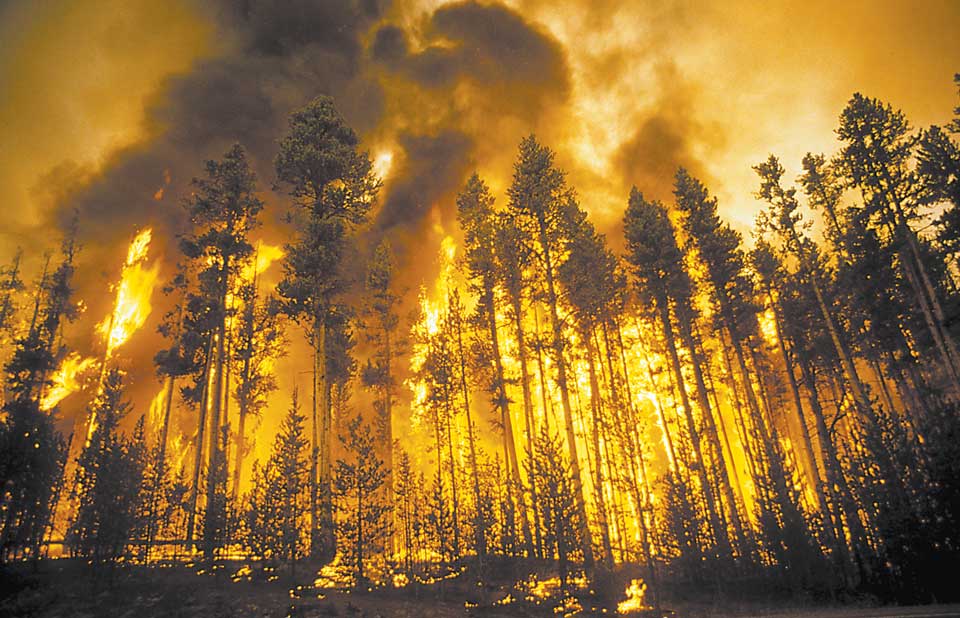
The events that lead to their awakening should be the dominant aesthetic descriptor after the tree type (a fire scarred treant bears those scars as cat faces).
And obviously what the treant wants should indicate their motives when encountered.
Thats for life
So is that (example of what bug kill can look like) (I took this picture!)
Treants and Wands
It is well established that the wood of a treant makes an exceptional wand. Perhaps some of their life force furthers the magic infused when created or maybe wizards just fetishize exotic materials when crafting their items of power. Regardless, the wands made from treant wood often share some personality traits with their parent. If the treant awakened in a fire the wand will be especially well suited to fire magics for example (but it also might be temperamental and brittle).
One of the greatest gifts a treant can give you is a length of their body to use as you see fit, thought they are notoriously hard to befriend.
Some wizards claim that once a wand is all used up you can soak it in water and then plant it in rich soil. If you are lucky and very nurturing it may root and leaf out again and a wyrwood tree will grow. Wyrwood is very useful, especially in the crafting of magical ships.
Every Season of Storms it moves, surging miles across the shallow Sea. The wind and currents drives loose sediment into it's maw, trapping the particles and making the water shallow...and habitable. It's miles across, not quite an island, but not quite just a drift of living wood either.
As the Season ends brave sailors approach with axes and torches to beat back the creeping green death. They have little success, the movement of this motile forest is dictated by the currents and winds. Some have tried, with varying success, appeasing the Spirits of nearby channels to divert the forest to their neighbors and avoid the doom that flows across the Sea.
Sometimes the Flowing Forest runs into an island. It is wrapped in a verdant embrace, and the creatures that call the Flowing Forest home set foot on terra firma for the first time in seasons. Sometimes these islands are inhabited, and those that survive that Season of the Sun and Fear tell harrowing stories of sighting brachiating predators hunting through the canopy, sinieous avians darting between the many loops of root and brach, and dark shapes in the waters beneath the trees...
Adventuring in the Flowing Forest
So there is a horrible massive tumbleweed forest that floats around the world and people hate it. So your players should totally have to go to the center of it to find lost artifact X.
As you pierce deeper into the forest the water is purified by the defense systems of the trees, eventually becoming freshwater. This creates three distinct zones within the Flowing Forest: Saltwater, Brackish, and Freshwater. Each band has a distinct set of tree species, wildlife, and challenges for an adventuring party. Each band takes about a day of travel (8 hours of unhindered movement) to pierce through, and my random encounter tables below assumes 4 two hour chunks of travel with one roll for each chunk and time for a one hour short rest. (I should write a post about how I handle wilderness travel...)
Green: Saltwater Zone, Blue: Brackish Zone, Orange: Freshwater Zone
Same as above, but the Flowing Forest is embracing an island
The Saltwater Zone:
Here on the outer edge of the forest waves and winds are still important factors, forcing open rips in the knot of roots and stems. Is pretty easy to navigate through, the trees are not super dense, the water is deep, and you might be able to catch a breeze to help propel you on your way. A few small groups of adaptedAutomata live in this outer edge of the Forest (they have lost their walking speed but have an equal climb speed). But this does not mean that it is devoid of danger...
Travel Notes: You can travel through this zone in a rowboat with relative ease if you stay to the channels and openings through the trees. If traveling through the trees out of a boat you must make a DC 12 Acrobatics check to move at half your base land speed. If you have a climb speed you may move normally through the trees at your full climb speed. Random Encounters and Hazards: 2d4
2) Hunting group of Automata natives, they are wary of outsiders but will trade with you and give advice about how to survive the Forest. They warn you to stay away from their settlements.
3) You catch an errant breeze that propels you deeper into the Flowing Forest, double movement speed for this chunk of travel (only effects boat travel, re-roll otherwise)
4) You come upon a wreck of a vessel tangled in the trees. Find 1d6+1 rations and roll on your favorite random treasure table
5) You disturb some salt encrusted pneumatophore roots who explosively eject their crystalline casing, 1d4+1 salt spear attacks at everyone in the party, (+4 to attack, 1d12 damage)
6) There are dark shapes in the water, and they are jostling your boat! A gam of 1d4+1 sharks are hunting (stats as Hunter Shark, 5e MM pg330), make a DC12 Acrobatics check to keep from falling in the water and maybe they will go away...
7) The tides turn and make traveling deeper into the forest difficult, half movement speed for this chunk of travel (only effects boat travel, re-roll otherwise)
8) You stumble upon an Automata settlement, made of woven dwellings in the branches of the trees above the high-water mark. They are very protective and the party gets -2 to all checks to try to parlay with them.
Don't pneumatophore roots look like they should have a sheath of explosive salt on them? I think so.
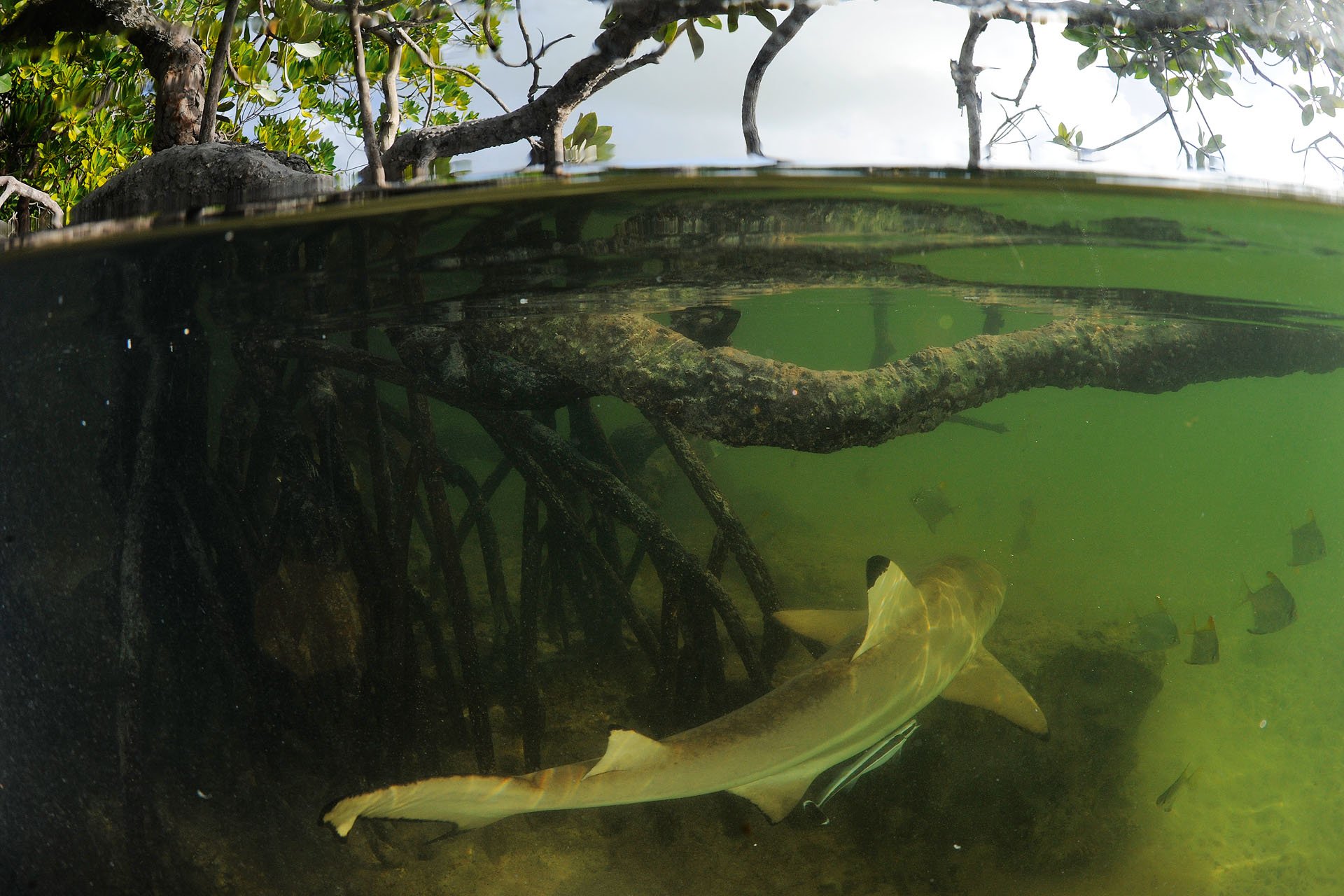
Beware what lurks underneath the water...
The Brackish Zone:
There are no longer any obvious paths through the trees. Each sluggish wave bumps your craft up against a web of roots. The trees are denser, the water is shallower, and the air is still and cloying. Insects are a true enemy, and there are chilling calls of strange birds and the horrible buzzing of insects echoing through the trees. The Automata tend to stay away from here, preferring the more open outer reaches.
Travel Notes: Travel through this zone is difficult. You can remain in your row boat and travel at half speed if you pass a DC 16 Survival/Sailing Check. If traveling through the trees you must make a DC 14 Acrobatics check to move at half your base land speed. If you have a climb speed you may move normally through the trees at your full climb speed.
Because travel through here character consumer double rations and double water to stay fit, if they don't get enough of either they begin to accumulate fatigue.
Random Encounters and Hazards: 2d4
2) Hunting group of Automata natives, they are wary of outsiders but will trade with you and give advice about how to survive the Forest. They warn you that travel deeper into the Forest is very dangerous and even they do not go much deeper than this zone.
3) You come upon a strangely woven mat of branches and roots, decorated with the hides of poisonous frogs, the skulls and feathers of serpent birds, and caked in red mud. It seems to be warning or shrine built by the Automata, if offerings are left the party receives Bless as the spell for the rest of the day, if they desecrate it or disturb it they receive Bane as the spell.
4) A flock of serpent birds bursts out of the trees with a chorus of screams and claw at the party as they flyby! They wheel about and ready another charge... 2d4+2 serpent birds (stats as Pseudodragon, 5eMM pg 254; no limited telepathy, size small, 4HD)
5) As you make your way through to forest you grab a branch and... (DC 14 Dex Save) On success: narrowly avoid grabbing a poisonous tree frog; On failure: grab a poisonous tree frog and take 2d6 poison damage and have the poisoned condition for the rest of this travelling chunk, making travel difficult
6) You disturb a hive of fire honey bees! 1d4 swarms of hornets well out of the hive (stats as swarm of wasps, 5eMM pg 338) Once defeated the hive can be ransacked for 1d3 applications of fire honey, which lends fire resistance for a chunk of travel when applied as a salve or gives 2d4+2 temporary HP for a chunck of travel when eaten.
7) The tides turn and make traveling deeper into the forest difficult, half movement speed for this chunk of travel (only effects boat travel, re-roll otherwise)
8) You stumble upon a random thing in the Forest: 1d3
As the tides turn you see deep in the mud submerged hull of an ancient wreck, somehow wormed deep into this zone, what could be in it?
A small structure suspended in the canopy, does someone live up there?
Massive flowers that lull the smellers to sleep (DC 12 Wisdom save against sleep, on failure nap for the chunk of travel and awake as if had a full nights rest, cannot be awoken), roll again to see what else happens while they sleep.
Totally a serpent bird. But like wayyyy longer.
And they are super agile and can fly no problem through tiny holes like this goshawk
The Freshwater Zone:
As you enter the heart of the Forest all but the foolhardy abandon their boats, though there are freshwater creeks flowing through the mats of vegetation. Here there is almost solid ground now... but every time you trust it or turn your attention away from it you fall into mud and muck. You basically have to climb from root to root to avoid the mud, but the branches are thick and low overhead. There is now abundant if muddy freshwater to refill water skins with.
Travel Notes: Travel through this zone is exceptionally difficult. Its extremely difficult to remain in your row boat, you get stuck in the roots/mud if you fail a DC 18 Survival/Sailing Check, otherwise are able to move at half speed. If traveling through the trees you must make a DC 14 Acrobatics check to move at half your base land speed, every failure drops you in waist deep mud. If you have a climb speed you may move normally through the trees at half your full climb speed unless you make a DC 12 strength check to smash through the dense canopy.
Because travel through here character consumer double rations and double water to stay fit, if they don't get enough of either they begin to accumulate fatigue. There is now abundant if muddy freshwater to refill water skins with, especially if they can figure out a clever way to filter the water.
Random Encounters and Hazards: 2d4
2) Massive flowers that lull the smellers to sleep (DC 12 Wisdom save against sleep, on failure nap for the chunk of travel and awake as if had a full nights rest, cannot be awoken), roll again to see what else happens while they sleep.
3) As you pick your way through the trees suddenly you see them, green-grey furred animals draped in the foliage, massive bodies heaving with calm breath, foot long claws twitching as they dream of ripping apart sweet fruits and sweeter flesh... You've found a female giant sloth sleeping warren! 1d4+1 (stats as giant ape, 5eMM pg 323, 8HD)
4) There is a small grove of fruiting mangroves here! Their boughs are heavy with large juicy fruit, and in the mud their are piles of sickly sweet fermenting fruit. Insects buzz happily around. Fresh fruit makes an excellent ration and there is more that the party can carry, and the fermented fruit juice might make an excellent accelerant for a flame...
5) As you make your way through to forest you grab a branch and... (DC 14 Dex Save) On success: narrowly avoid grabbing a poisonous tree frog; On failure: grab a poisonous tree frog and take 2d6 poison damage and have the poisoned condition for the rest of this travelling chunk, making travel difficult.
6) You hear a crashing through the trees and as the swinging shape bursts into view it bellows a deep yawp. This giant sloth looks inquisitive, and very big... A male giant sloth (stats as giant ape, 5eMM pg 323) has found the party as it hunts for: 1d4
A female
Fruit
The tallest tree it can find to nap in
A protein rich meal...
7) A flock of serpent birds bursts out of the trees with a chorus of screams and claw at the party as they flyby! They wheel about and ready another charge... 2d4+2 serpent birds (stats as Pseudodragon, 5eMM pg 254; no limited telepathy, size small, 4HD)
8) The nests of a group of serpent birds with 1d6+1 eggs and lined with shiny things they have found (roll on your favorite random treasure generator).
The giant sloth...
...the stuff of nightmares.
Other Thoughts on the Flowing Forest:
If your party comes up with clever solutions to the hazards and challenges of travel through the Flowing Forest reward them!
Examples:
They learn to wear gloves so as to avoid the poison tree frogs, turn that entry in the table to simple easy travel.
They are a party of sufficiently high level druids and they all turn into monkeys, so of course they swing easily into the heart of the forest!
They just fireball the shit out of the trees they could probably boat more easily deeper into the forest.
The intent is to make the forest a challenge, but not impassable. Once you are aware of the dangers you can find solutions to them. Think about this great scene from the Princess Bride:
Travel is and should be difficult, but that also means that it falls to the DM to create an appropriately enticing reason to want to pierce the heart of this hated forest. Here are some ideas though:
The center of the forest is the Big Dungeon that the Big Artifact is in. Probably a massive inverted ziggurat with dramatic waterfalls coursing down the terraced sides to a freshwater lake, at the center of which is the tip of a another ziggurat and the party has to descend its flooded levels and figure out what brought about the ruin of this once mighty empire and steal its shit... or something.
A wilderness survival episode of shipwreck on hard mode. They could make a sweet raft.
Could be a good location to hunt for rare medicinal plants.
Could be tasked with destroying/ diverting the Forest to protect an island. What binds it together? Some wickedly powerful Spirit?
What I like about this wilderness is that it uses things that real mangroves do (form bands based on salinity tolerance, expel salt through their roots, house many various fish in their roots) and cool things about various animals (like the goshawk flying through forest canopies as shown above, some birds really do collect shiny things for their nests, giant sloths existed (but they were not ferocious omnivores), poisonous tree frogs are real and tiny and deadly) as a jumping off point for interesting wilderness travel. Ecology is rad, and reading a little bit about it definitely is a wellspring of ideas.
*Also when this post was in its draft stages this post came out also about mangrove wilderness travel!*
"Now I am not arguing that I want to have D&D accurately simulate or describe forest ecology, I don't think that's especially interesting. What I am arguing for is a more complex look at nature oriented races/classes..."
That's not strictly true. I have thought about integrating the principles of forest management/ecology into the way forests are depicted in my games. This is my first attempt at making forest ecology gameable, if you want to skip the ecology lesson look for the next post!
Principles of Forest Ecology:
To better understand forests lets discuss briefly their ecology. Ecology is the study of a of system living things and their relations to themselves and their the non-living environment. Below are some examples of each.
Abiotic Factors: inorganic soil characteristics, water availability, temperature variability, light availability, slope aspect, etc
Biotic Factors/Interactions: Trees competing for light in a forest canopy, plants using allelopathy (chemical warfare) to inhibit competition, birds dispersing seeds, beavers biting down trees, wolves influencing grazing patterns of deer that eat regenerating trees, etc
When considering these factors that influence a tree through time we can begin to look at the "natural history" of a species. A good example of why this temporal consideration is useful is the dispersal patterns of tree species we find today in North America. Due to the retreat and advance of species through the periods of glacial and interglacial in the Pleistocene epoch some tree species can be mapped back in time as they reclaim historic ranges that up until (geologically) recently have been covered in glaciers.
These diagrams are good examples of how we think about forest migration, they are worth enlarging!
I love reading about natural history, its like the saga of a tree species. I'll write about it some time
All of this information helps us understand what conditions a species is tolerant of and how they cope with the unique challenges of their environments.
Disturbance ecology is the study of how ecosystems interact with disturbances. Wild fire is an easily recognized example of a disturbance; but wind throw, flooding, ice storms, land slides, out of season freezes, insect infestations, and fungal pathogens are also examples of forest disturbances. These are the challenges that forests are presented with and adapted to.
The lodgepole pine forests of the northern Midwestern states in the US are dependent on a high severity (i.e. high mortality) but very long return interval (~100-200 year) fire regime to reproduce, their cones wont open without the heat! The wetter forests of the northeast US are used to wind throw and ice storm events that kill single/small groups of trees to open gaps in the forest canopy. The examples are endlessly variable.
This was appropriate in 1988, but the subsequent fires are killing all of the regenerating trees because the fire return interval was too short. Give it another hundred years and it would be ready (ecologically) to burn again. This is a great example of why a changing climate is such a challenge to manage for.
This is also normal/appropriate. Larger and older trees are blown over and clear space for regeneration.
One of the primary objectives of a forester is to emulate the natural disturbance regime of a forest system. Ideally a forester is able to harvest (and therefore manage!) in a way that the forest they are taking care of is capable of reacting to and reforesting after. In the examples above this means that long cycle clear cut systems may be appropriate choices in the midwest, while single tree or group selection methods are more appropriate in the northeast.
Mangroves: A Super Bad Ass Forest
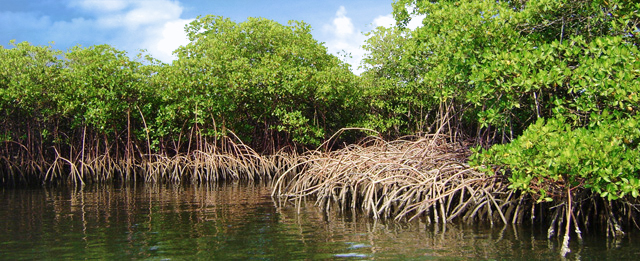
Mangroves are super bad ass trees. They grow in the intertidal zones of coasts from about 25 degrees south to 25 degrees north (tropical and sub-tropical latitudes). They are super bad ass because of their roots. They can filter out saltwater and withstand anaerobic conditions. They have floating seeds that can travel for hundreds of miles and root on a new continent.
Here is their natural range
The primary constraint on mangrove distribution is salinity. They can't compete effectively with species in freshwater riparian zones because they have invested too much in a biology that lets them withstand some intense stresses. This helps explain their species distribution in the brackish zone of estuaries, some species can withstand more salt than others and will form bands of species as you head inland and the water becomes less brackish.
Here are some pictures:
So now we know all of these things about mangrove forests, lets make them a horrible place to visit for your players in the follow up post!