Showing posts with label Ships. Show all posts

Tuesday, May 23, 2017

Plying the Seas for (Some) Adventure and (Mostly) Profit

"Hey kid, wanna buy some sheep?"
So I have a player in one of my Ánemos games that worships Oros, god of trade and mercantilism. Literally ever time they are in a port or meeting a random guy on the ocean he trys to make a business deal, its great. I didn't really have a good way to handle this at first, so I wrote up a random goods table, assigned each good a value per ton and a rarity and have been using it ever since. And since I wrote it I guess I could share it here, I even mentioned it in a post from months ago!

I use these by rolling on the d100 table when the party encounters a merchant ship (most of these are either common galleys (150 tons of cargo space) or trading cogs (300 tons of cargo space)) (ship stats here) to figure out what goods they have aboard. If you want to really systematize this you could roll a d100% to determine how full the trader's cargo hold is and roll on the goods table and the quantity per rarity table to fill up their hold to their current level, but I have found that that level of detail is often not super important.

I have found this table to be pretty useful for determining the primary industries of islands or even the domains that Gods and Spirits are interested in. So that's cool.

Random Good Table:
Livestock Head to Ton Conversion Rates
Quantity Per Rarity Rates
I also wrote a little calculator using Excel's random number generator to simulate a variable price when selling goods in market. The math is pretty simple, and it seems to work well:
Selling Price= Common Price*(1+x)
Where: x=(random value between -25% and +25%)/y
Where: y=1(if very rare), 2(if rare), 3(if uncommon), 4(if common) 
[I especially like that the rarity controls how big the price variation is. Common goods are only ever -6.25% to +6.25% above or below the common market price, they are more stable good because they are common. Rarer goods can have bigger swings in price, like in real life! Economics simulation tirade over]

Or you can just say fuck it, Connor you wrote a god damned math for D&D what the fuck, give me the math in a little calculator for fucks sake. Okay.

Sunday, October 30, 2016

Play Report: Naval Combat

The other night I got to try out some of my new and shiny rules for naval combat.

It went okay, here are some notes from my players and myself:

  • Super fun idea
  • Movement worked out okay eventually, its hard to simulate momentum and slow turning.
  • Ships too hard to sink with ramming, I think I need to give them way less health and keep ramming damage very high.
  • Hard for every player to feel involved with the combat when there are many ships, better if everyone captained their own ship.
  • Ships are still fucking tight, but hard for DnD to simulate large scale conflict, may steer players away from formal naval fights and more to like 1v1 ship duels with pirate ghosts.

Oh, also they got a ship! It's an unarmored Arsuf Longship of average make, they helped capture from a blood hungry Clan while helping their buddy Clan. Now they get to find a crew and assign a Captain and get some cargo and become traders cause who doesn't love trading simulations? (Gosh, thats a future post waiting to happen).

Friday, October 14, 2016

It Is Not the Destination but the Journey... Part I: Sea Travel

After reading a flurry of blog posts by other great writers on the "problem" of making travel in tabletop RPGs fun/interesting/story serving/useful I have tried my hand at making a travel table that I can use in my Ánemos campaign.

I've used it for about a month or two now, and it seems to work pretty well. The important thing to keep in mind is that each of these events can be interacted with, they aren't the end all be all. If you roll a 4 and a 2 you get "sneaky sand bars" the ship is beached and it takes all day to wait for high tide and digging in the sand to get it out. Now say that the party wizard has some sort of spell that turns things into water, they could use it and unbeach the ship in a jiffy, successfully addressing the issue with problem solving. So encourage and allow for creative solutions.

Roll 1d8
Encounter
Sub Rolls
Sub-Encounter/Effect
1
Coral Reef
1
Abundant fish! Extra rations
2
Hull stuck on the reef, day lost waiting for
low tide
3
Mermaids (gossip or food?)!
4
One roll on ingredient table
2
No safe harbor
--
Sail another day farther, but point of
exhaustion the next day
3
Heavy Winds
1
Make good head way, travel two days
distance, but point of exhaustion the next day
2
Blown off course, loose a day of travel,
and point of exhaustion the next day
4
Small Inlet
1
Light House: Aids in navigation, travel two
days distance
2
Sneaky Sand Bars: Grounded, loose a day
of travel
5
Other Ship
1
Trading Galley, trade or gossip!
2
Pirates! Lives or money!
3
Shipwreck! Loose day of travel if searched
4
Wandering cleric/paladin seeking nearby Spirit
6
Psári pod
1
Adolescents (1d8+2), migrating
2
Adolescents (1d8+2), hunting!
3
Adults (1d4), migrating
4
Adults (1d4), hunting!
7
Sea Monster
1
Kraken
2
Dragon Turtle
3,4,5
Giant: Snake/shark/octopus/other animal
6,7,8
Spirit! Roll on Spirit Generator
8
Ship Board Event
1
Normal day, so roleplay!
2
Supplies have spoiled, loose half the rations
3
Crew is exhausted, demand a few days in port
4
Shipwreck! Beached on near by random island

Floating islands optional

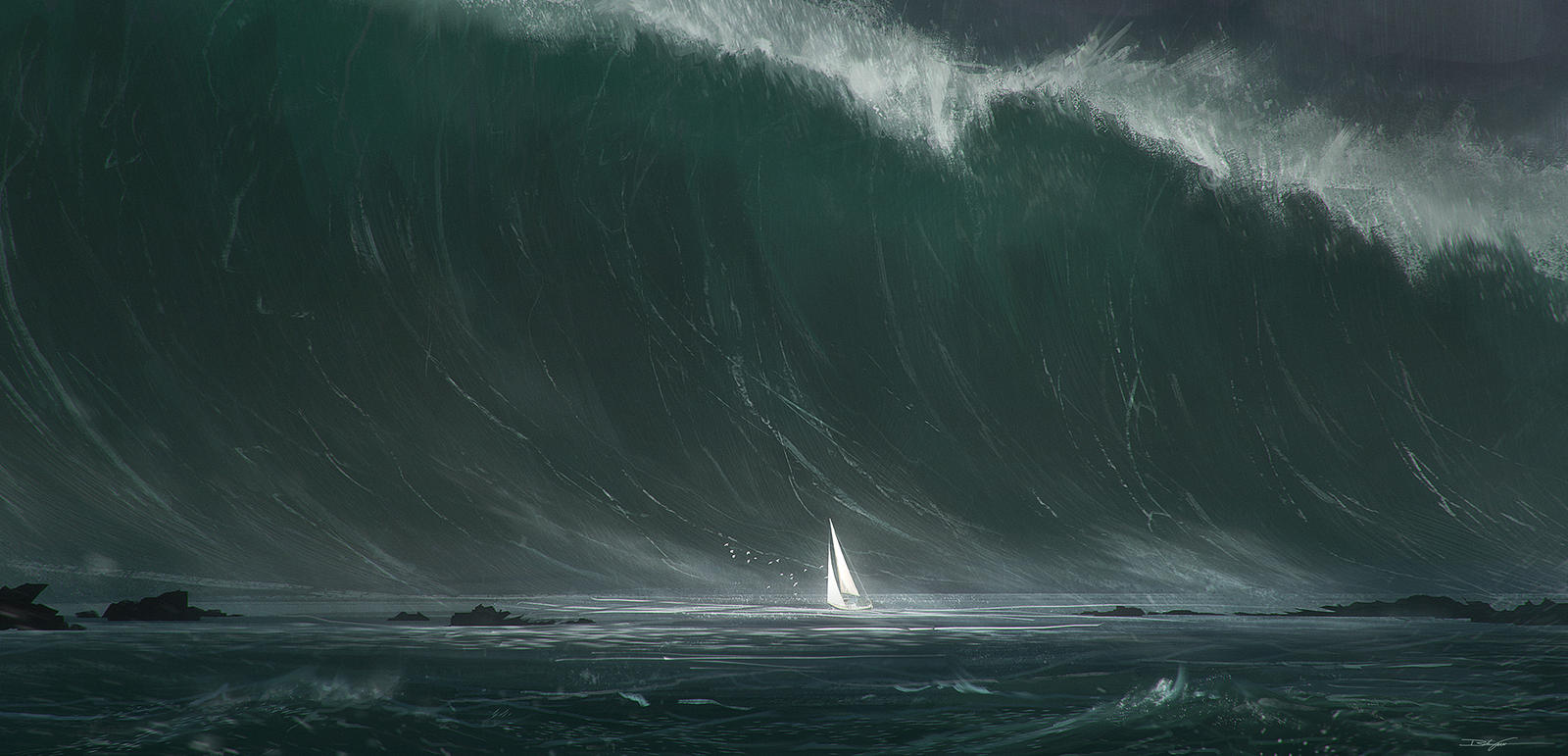
A tidal wave is a good reason for a ship wreck
Probably not Ánemos, maybe Vindjord


Tuesday, October 11, 2016

Into the Deep, or How to Hunt Magic Whales in Fantasy Land

So I wrote some posts on sailing. Now you get a post on sailing and hunting magic whales for profit and fun and adventure.

The Ecology of the Psári 

Psári (the Greek word for fish) are the great leviathans of the shallow seas of Ánemos. Indeed they are the foundation of all sea life according to the merefolk, when you can convince them to talk about serious matters for a little while. The merefolk also call them the fish that never stops growing and the dicks of the sea, but we don't listen to merefolk too carefully.

They are born small, lithe and silver in broods of hundreds born out of their mothers secret egg den. When this young they flit around the reefs in schools of thousands eating plankton and algae, and many other fish eat the Psári at this stage and few survive to adolescence.

Once they are large enough the Psári leave the reefs for the deeper waters of the channels between islands and reef shelves. This is where they begin to be the hunters, eating fish that once hunted them. At this point they are long and their tails are powerful, their silver flesh has given way to stony scales of grey.

They look kind of like this

As adults the Psári are massive, more than eighty feet long, and the undisputed kings of the islands. They have lost their speed in favor for massive strength, and many lesser fish follow behind the adult Psári in hopes of cleaning off their algae crusted scales or getting a morsel of some unfortunate prey the Psári have killed.

At this size the Psári  are too large to support themselves through purely carnivorous activities, their diets begin to shift towards their infant food of plankton and algae. This change in diet is accompanied by a change in the structure of their teeth, becoming proto-baleen, capable of both filtering plankton and rending meat.

Example of proto-baleen teeth in leopard seals

Hunting Psári

Its like this, but the fish is bigger and you boat is worse and its really hot.
Okay, so your PCs are convinced that they want to go on a Psári hunt and earn some cash. If they are low level they wont have a boat, so they will have to sign on with a Psári hunting boat (they are called Psaróvarka). The PCs will have to haggle for thier lays of the profit at the end of the voyage, the captain would get something like 1/17th, the firstmate 1/22nd, a harpooner 1/75th, a smith 1/100th, and a crewman 1/140th. Martial characters should be able to convince the captain and first mate of their ability with a harpoon relatively easily, though magical or skillful characters might have a tougher time proving their worth.

Psaróvarka take a while, like a a few weeks to a few months. So its probably best to present the voyage as a montage of sorts, with the hunt being the main piece of action. When the PCs are traveling on their own their is also a chance that they will encounter a pod of Psári, as per my random sea encounter table, at which point they can choose to try for a kill. (Incidentally, Psári also sometimes hunt ships when especially hungry, or in heat, or hurt, or defending a kill, or...)

Unlike ship-ship naval combat Psári hunting takes place at the standard rate and scale, because the hunters are in row boats with harpoons. Treat harpoons like javelins, but when they hit they have lines attached to tow the boat along as the Psári bleeds and fights. Every round make a strength check for the Psári to see if it can snap the lines, getting harder the more lines there are.

Adolescent Psári: Huge beast, unaligned
AC: 14 (silver scales)
HP: 115(10d12+50)
Speed: swim 50 feet
Ability Scores: STR 23, DEX 14, CON 21, INT 3, WIS 10, CHA 8
Saves: STR: +6, DEX +2, CON +8, WIS +3
Perception: +3, Passive 13
Multiattack: The Adolescent Psári makes two attacks, one bite and one tail smash.
Bite: +8 to hit, 5ft reach, one target, 2d10+6 piercing damage.
Tail smash: +8 to hit, 10ft reach, one target and ship, 3d12+6 bludgeoning damage

Adult Psári: Gargantum beast, unaligned
AC: 16 (scales of stone)
HP: 216(16d12+112)
Speed: swim 30 feet
Ability Scores: STR 27, DEX 8, CON 24, INT 6, WIS 12, CHA 8
Saves: STR: +9, DEX -1, CON +12, WIS +6
Perception: +6, Passive 16
Bite: +13 to hit, 10ft reach, one target, 4d12+8 piercing damage.
Tail smash: +13 to hit, 20ft reach, one target and ship, 10d6+8 bludgeoning damage

Selling Psári

Everyone in Ánemos is at least mostly pescetarian, and Psári is the biggest and best fish to catch. There is a vibrant trade of their parts, and most cities will have a fish market near the docks selling Psári parts. Even smaller settlements will get together and buy a few tons of Psári carcass annually to feed them through the year.

Fish Market!
Not only is their meat and blubber used for cooking and heating, but their bones have wonderful flexibility and strength and they are used in many tools and weapons. Their scales are strong and do not rust in the salty spray of the ocean, leading many to make pieces of armor out of them. Their massive hearts are the most valuable of all, prized for their use in rituals and alchemy.

Goods and Prices:
Good
Sell Price/Ton
% of Body Weight
Psári Meat
40 drachma
35%
Psári Bone
80 drachma
20%
Psári Blubber
120 drachma
15%
Psári Scales
200  drachma
1%
Psári Heart
1,000 drachma
0.5%
Size Chart:

Adolescent
Adult
Length (feet)
30+2d10
60+4d12
Weight (tons)
80+2d10*2d4
160+2d6*2d6
Age (years)
40+1d6*1d10
100+2d8*3d10


Saturday, October 8, 2016

More Rules for the High Sea

After my last post my players used my rules in game and had some notes for me, so I've put some thought to it and come up with some more explicit rules for naval combat, especially modeling ramming better.

Moving your ship in combat

So ships have momentum while moving through their fluid environment. Unlike on Terra Firma you cannot simply dig in your heels and stop or lean in and speed up let alone turn about quickly. So how do we model different ships being more nimble than others? I've assigned them a maneuverability score and created a sketch of naval combat, and this is how it works.

Naval combat is slower and on a larger scale than cramped combat in a dungeon, so rounds in naval combat are half a minute long instead of 6 seconds. Also, each square on the battle mat is 25ft instead of 5ft.

This brings up the issue of character actions during naval combat rounds. I have decided to allow 1 action per round (since movement is already being taken care of by the ship), things like: row ship, man the helm, fire ballista, shoot bow at enemy, call the wind, or cast a spell. Most of these are self explanatory, but how many shots should an archer get per round? I have settled on three, six when they get high enough level for multiple attack actions per attack. I have a reason*, I promise. The same goes for spell casting, max of three per round.

So naval battles are big and long and characters can do things.

Ships now have a maneuverability score, this describes both how quickly they can change their speed and how easily they can turn around. These range from 1-4 (and can go higher with higher quality ships):
-A score of 1 means on a given round you can increase or decrease your ships speed by one unit (25ft) and a score of 4 means you can increase or decrease your ships speed by four  units (100ft).
-When turning a score of 1 means your ship must be going its slowest speed (25ft/round) to turn more than 45 degrees away from your initial bearing and a score of 4 means you must be within four units of your slowest speed (25ft-100ft/round) to turn more than 45 degrees from your initial bearing.

Ramming for Fun and Profit

In order to ram you must be going full speed. That means that ships that are more maneuverable can ram more often. Ramming is, incidentally, one of the best ways to do a lot of damage to enemy ships. Fire is a good option too.

But often it is in the PCs interest to keep the ship intact, in fact ships are modular and mobile pieces of wealth. And so boarding becomes more desirable. Hmm, I have to think about how to insensitive more ramming.
This is the most important thing
One of my players did some quick math on the proposed ramming damage and pointed out it would take around 20 successful rams to sink another ship. Thats not acceptable, it should take only a handful of rams to scuttle a ship, especially when constrained by a "full speed ahead" requirement.

Look at this table and understand who I fixed it. I used a galley as the base ship.
Quality
(old) Damage
Average
(new) Damage
Average
-1
2d6-2
5
8d6
28
0
2d6
7
10d6
35
+1
2d6+4
11
12d6
42
+2
4d6+8
22
14d6
49
+3
5d6+12
29.5
16d6
56
+4
6d6+16
37
18d6
63
+5
7d6+20
44.5
20d6
70

Any way, I think this stuff is usable. I'll let you know after the next session.

*The reason is that the "pinnacle" of historic archers, the English longbowmen, shot only around 6-7 arrows a minute at their fastest. So off the bat they are shooting as quickly as a historical benchmark and when they get high enough level they shoot TWICE as fast! (But also I don't want them to be able to just kill the whole crew of enemy ships with one archer...)

Sunday, September 25, 2016

Sea Travel in the Ancient World and Sea Travel in RPGs Set in the Ancient World

A Brief History of Sea Travel

Humans began using boats to get around a long time ago. It started with using wood as a buoyancy aid for swimming, then we started to tie them together into rafts, these eventually had sails attached to them, then better rigging was invented and compasses where made and then ships were made out of metal and had lots of guns.

But for our purposes we are interested in ships that the ancient Greeks sailed, or at least people like the ancient Greeks in ships maybe similar to what they might have sailed. What it comes down to is this:

  • There are lots of oars needed to move a ship around, they solved this by having multiple decks of oars (trireme literally means three decks of oars). Oars meant you could go fast and turn better than just with sails.
  • You need a very large crew to move around a big ship.
  • The sails are square, not triangular, and have pretty simple rigging. This means that they sailed with the wind for the most part, not across it or against it especially well.
  • The Aegean Sea wasn't that big and there were islands everywhere. It was probably very difficult to sail out of sight of land, meaning that they had little need to develop advanced navigation systems.

Sea Travel in Ánemos, or "I should buy a boat"

While most people in Ánemos have never even left their village, let alone their island, those that do need ships. But the Sea is also the main source of food and lively hood in Ánemos, so even the most backwards bumpkin knows their way around a row boat or fishing sloop. This means that mechanically all PCs are competent sailors and can work in pretty much any position on a ships crew as needed. Everyone in Ánemos wants a ship of their own as a way to gain prosperity and independence, plus fares are expensive!

Using the some of the ship stats from the 5E DMG as a jumping off point, I made up some ships. I also liked +Joseph Manola 's idea about making mounts and therefore travel more interesting and useful, so I created a similar "quality" spectrum on which to describe ships.


So your players finally get a boat, they are so exited! They don't have to pay fares between islands any more, they can sail in dangerous waters that no one else would take them to check out that spooky island, they have at least a little cargo space to start trading and making some money just for traveling, they can hunt Psári, and the sea is theirs to ply!

But! They now need a crew they have to pay and feed (I like to use +Joseph Manola 's rules for the "extras" class to simulate the crew). They now own something valuable so when they dock at cities they have to pay moorage fees to keep it from being stolen while they are taking care of business in the city. Navigation is now up to them, unless they buy an expensive map or hire a skilled navigator getting from Point A to Point B is a lot less sure.

What I am trying to point out is that the party's ship is a great resource that should be loved and taken care of and invested in, not unlike their hometown. The whole premise of the setting is basically a wave crawl style adventure, so a ship is almost assumed at a certain level of play.

Ship Descriptions and Stats

Common Galley: The all around utility ship, with room enough for passengers and cargo. Faster than cogs, but not built for war.
Trading Cog: Large slow moving ships with deep cargo holds, these are common on the high seas. Many rowers are needed to move their great bulk and ballast is required when their holds are empty.
Fishing Sloop: Small sail boats favored by fishermen, just large enough to make small journeys between nearby islands.
Row Boat: Basic row boat, cannot be used to travel across between islands due to strong currents. Most ships carry at least one with with them, each one takes up 1 ton of cargo space.
Psari Hunting Longboat: A sturdy and well built rowing boat used when hunting Psári. Each one has a few harpoons and takes up 2 tons of cargo space when not in use.
Minoan Trireme: The backbone of the Minoan Republic's Navy, these tall and well built ships prowl the Inner Sea and enforce Republic law. Built to carry marines from place to place.
Minoan Maris Castra: The crown jewels of the Minoan Republic's navy and the largest ships ever built, there are only three in existence at a time. They lead the Navy in war, but otherwise act as merely symbols of power. Massive, heavily armored, and slow.
Arsuf Longship: Lean and fast, these are weapons used by the Clans of Arsuf to raid and flee quickly.
Arsuf Clancraft: The pride of every Clan, these are mobile homes and the Clan's most important possession. With a full crew, these ships can sail longer and faster than almost any other ship on the Sea.
Chalcis Wyrship: Every timber was carefully chosen, every join is caulked with enchanted seashell dust, and the sails have spells sewn into them. They run light and fast on the water almost seeming to sail themselves. With a Windcaller crew of Chalcis mages these are the fastest ships in the world.


Ship Stats:
Cost: In Drachma, must be paid upfront if buying a ship out right or paid in materials and labor time if commissioning a ship. Building a new ship takes 1 year and improving a ship takes 6 months. You can also take out a loan from the Obsidian Bank if you are willing to pay the interest...
HP: How much damage a ship can take and still be sail-able. After 0 HP parts can be scavenged or the ship may be able to be rebuilt
AC Base: What a basic ship's Armor Class is, see quality and improvements below.
Damage Threshold: The minimum amount of damage to be done to inflict damage on a ship, fire damage ignores this threshold
Ramming Damage: All ships can ram other ships, and even some large sea creatures. This is the base damage dice that a ship of this kind deals.
Speed: How fast a ship sails, I have been assuming that the can sail for 10 hours a day and laying anchor in shallow water or near an island at night.
Crew: The minimum number of crew needed to sail the ship, with less there are pretty sever penalties until the ship is un-sail-able
Passengers: How many people other than the crew can be aboard
Cargo: The amount of space in the hold of the ship, measured in tons. My trade table measures everything in tons. Portions of the cargo hold space can be converted, see improvements below.


Ship Quality and Improvements

Ships have variable quality. You can think of this as akin to getting a +1 sword: it's better at being a sword than a normal sword. When you get a +1 Galley its better at being a Galley than a normal Galley. They sail smoother, the hit harder, and they are built better. It takes an especially talented shipwright to build such a ship, and they charge accordingly.

At +4 and +5 you get into magical ship territory. These are certainly not for sale and include legendary ships like the Argo or the Flying Dutchman. They might have the ability to fly or to sail without a crew, though each has its own unique properties and formidiable captains to contend with (see +Arnold K. 's excellent series of posts on pirates/assassins for an idea who these nutty people are: Pirate, Pirate, Assassin, Assassin, Assassin).


Here are some ship add ons:
Weapons:
  • Ballista: Shoots large bolts, often with lines and winches to haul in enemy ships of Psári with, occupies 5 tons of cargo space. 2,500 €.
  • Ingnis Siphon: Expels a 40ft cone of flame and automatically catches ships on fire, occupies 5 tons of cargo space. 5 tons of cargo space and 5,000 € for the Siphon, 100 € for the alchemicals for each shot.
  • Catapault: Throws large projectiles, often stones but also capable of throwing chain shot into rigging to slow enemies or barrels of combustibles to burn other ship (special projectiles attack with disadvantage). 10 tons of cargo space and 5,000 € for the catapult, special projectiles vary.
Improvements:
  • Outrigger: Fishing sloops only, for 500 € adds 1 extra ton of cargo space.
  • Prisoner Cells: For 1000 € permanently remove 1 ton of cargo space, builds a secure place to keep 5 prisoners.
  • Ship's Galley: For 2,000 € permanently removes 10 tons of cargo space, builds a place for the crew to cook and eat, +2 on crew morale checks.
  • Passanger Quarters: For 2,000 € permanently removes 5 tons of cargo space, builds comfortable quarters for passengers. This makes 5 extra passenger slots available and the new slots cost double the standard fare.
  • Psári Processing Deck: For 5,000 € permanently removes 10 tons of cargo space, builds an area on deck where Psári can be butchered, their lard rendered, their bones dried, their scales stacked, and their hearts preserved. Allows a hunted Psári to be processed into it's parts instead of hauled to port while rotting.
I like the add on system because the party can really customize their ship how they see fit. They can build a cruise ship full of passenger cabins and cart rich people between islands, build a lot of prisoner cells for their raiding, build a whaling ship, or just load up with ship sinking weapons.